Pox Diseases
 |
| Dried skin lesion |
|
© USDA
|
Most pox diseases occur in Africa and Asia. Sheep and goat pox occurs in Africa north of the equator and in Asia.
Pox diseases are viral diseases which affect many animals, including humans and birds but not dogs. Different species of animals are affected by different pox diseases: camels are affected by Camel Pox, Sheep and Goats by Sheep Pox and Goat Pox, Pigs by Swine Pox, poultry by Fowl Pox and cattle by Cow Pox and Psuedo-cow Pox.
 |
| Sheep Pox |
|
© R. Paul Kitching
|
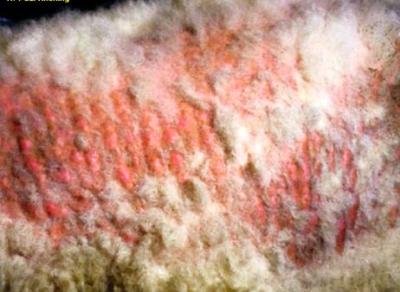
Sheep pox symptoms
Infection may be followed by wounds all over the body (e.g. Sheep Pox) or in one area (e.g. Pseudo- Cow Pox). Some strains of pox virus with reduced virulence are used to immunize against some infections, the classic example being the global eradication of smallpox in humans by immunization with strains of live vaccinia virus, which is a laboratory generated virus related to Cow Pox.
Other diseases which cause skin lesions can be confused with pox infections e.g. Bluetongue, Foot and Mouth Disease, Mange and Contagious Pustular Dermatitis (Orf).
Mode of spread
Infection is acquired either by inhalation or through the skin. In certain instances the virus is transmitted by biting insects (e.g. Fowl Pox and Swine Pox).
Cow Pox
True Cow Pox is a rare disease. The vaccinia virus previously used to vaccinate humans against Small Pox was in many instances responsible for explosive outbreaks in cows as infections closely mimic cow pox. In cattle, cow pox is a relatively benign disease affecting the teats of lactating cows. However the virus which causes cow pox can affect cats, appearing first as a wound around the head followed by wounds elsewhere on the body.
Cases of Cow Pox/Cat Pox have only been authenticated in Western Europe. Vaccinia outbreaks in cattle however have been common when people were being vaccinated against Small Pox. More humans have probably been infected by Cow Pox/Cat Pox than cows.
Signs of Cow Pox
- Cattle become sick 5 - 10 days after they get infected
- They have small red sores on the teats at places where there are small injuries. The sores soon have scabs over them. When the scabs fall off they leave a crescent of smaller scabs.
- The teats become rough with many grayish/yellowish scabs.
- In cats a single pock is followed by the appearance of multiple widespread wounds
- Animals usually recover in 2 - 8 weeks.
Pseudo-Cow Pox
is a common, mild infection of the udder and teats of cows and occurs worldwide. Other names for Pseudo-Cow Pox include Bovine Papular Stomatis (BPS) and Milkers' Nodules.
Pseudo-Cow Pox is visible as eroded patches on the teats and udders of lactating cows, whereas BPS is acquired by calves suckling cows with active Pseudo-Cow Pox and is visible as circular patches around the nose and mouth and by a pimple-like inflammation on the margins of the nostrils, inner surfaces of the lips, and the edges of the tooth sockets.
| ATTENTION: Human beings can be infected with BPS and the disease in humans is called Milkers' Nodules. |
Pseudo-Cow Pox mode of spread
Calves are infected when they suck the teats of infected cows. They in turn infect in-contact susceptible calves by licking. Thereafter the virus becomes inactive and resurfaces whenever there is stress. It is suspected that the first case in a dairy herd is a resurfaced infection in a cow originally infected as a calf. Thereafter, the virus is spread to the teats of other milking cows by the hands of milkers, cloths, by contact and via teat cups.
Signs of Pseudo-Cow Pox
- Lesions begin as small, red pimples on the teats or udder. These may be followed rapidly by scabbing or small blisters may develop before scabs form.
- Scabs may be abundant but can be removed without causing pain.
- As the lesion begins to heal, it becomes raised, healing from the centre, and leaves a circular ring of small scabs. This stage is reached in 7-12 days.
- Some wounds persist for several months giving the affected teats a rough feel and appearance. There is little immunity and the disease tends to recur. It spreads slowly, heals slowly, recurs cyclically in individual cows, and in herds the disease can last for up to 18 months.
Signs of Pseudo cow pox in calves (Bovine Papular Stomatitis)
- Calves show signs 3-7 days after they are infected
- The pimples increase in size daily until they are 1-2cm in diameter.
- The initial wounds persist for 3-4 weeks and then heal quickly, to be followed by new wounds 1-3 weeks after the onset of the first ones.
- The wounds expand, forming circles of different colours - yellow, grey and red.
- As old wounds heal, new ones may form, so the disease may be protracted for months.
- Animals are not ill and the disease is not fatal.
- Occasionally the tip of the tail may be affected, leaving a raw, denuded area. Infected animals are chronically unthrifty and are usually culled. The condition is called 'Rat Tail Syndrome'.
Prevention and Control
- Infected animals should be segregated. Avoid moving infected animals to areas without the disease.
- Individual paper towels should be used for washing udders.
- Back-flush milking clusters to reduce cross-infection
- Newly purchased cattle should be quarantined for at least 14 days and their teats carefully inspected for evidence of infection.
- Control by vaccination has been attempted but is of doubtful value.
- Avoid using anything that has touched infected animals.
- Make sure that newborn animals drink enough colostrum.
- Those people who milk infected animals should not milk healthy ones. It is best not to drink milk from infected animals.
Recommended treatment
- Only treatment of symptoms without curing the disease is possible. The application of a soft cream before milking and an astringent lotion after milking facilitates recovery. Hands and cloths should be disinfected.
- If the sores are bad or deep put antibiotic or antiseptic on them. Be careful not to spread the disease further. Use wound dressings that dry.
Camel Pox:
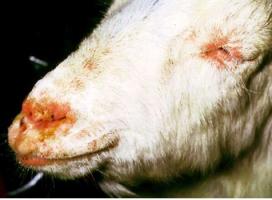
Camel Pox is a malignant pox of camels, characterized by fever, skin wounds all over the body and a low, but significant death rate. Spread is both direct and indirect. In fatal cases, the head is most often affected, with lesions concentrated around the eyes, often blinding the animals. In addition there is widespread facial swelling.
A vaccine for camel pox exist, but has so far been too expensive to import to Kenya.
 |
| Goat Pox |
|
© R. Paul Kitching
|
 |
| Grey lesions of skin of goat |
|
© USDA
|
Sheep and Camel Pox:
These are serious and often fatal diseases characterized by widespread skin eruptions. Fever and a variable degree of systemic disturbance develop. Eyelids become swollen and a mucous discharge with pus encrusts the nostrils. Widespread skin wounds develop that are most readily seen on the muzzle, ears and areas free of hair and wool. In severe cases wounds develop in the lungs. Transmission may be by direct contact, by biting flies or be airborne.
Prevention and Control:
Live, attenuated virus vaccines give good immunity.
Pigs:
All ages may be affected but Swine Pox is most often seen in young pigs 3 - 6 weeks old. Transmission is generally via stable flies or the biting louse.